
Xi's the Man... for now
Updates from the People's Republic, Islamic Republic, and.... One Republic

Everything that kills me makes me feel… never mind, you’re dead.
With the arrest of Zhang Youxia and Liu Zhenli, the purge of PLA generals has reached one of its two possible logical conclusions. No real generals are left in the Central Military Commission - just Xi and his political commissar. Count them stars, will you?
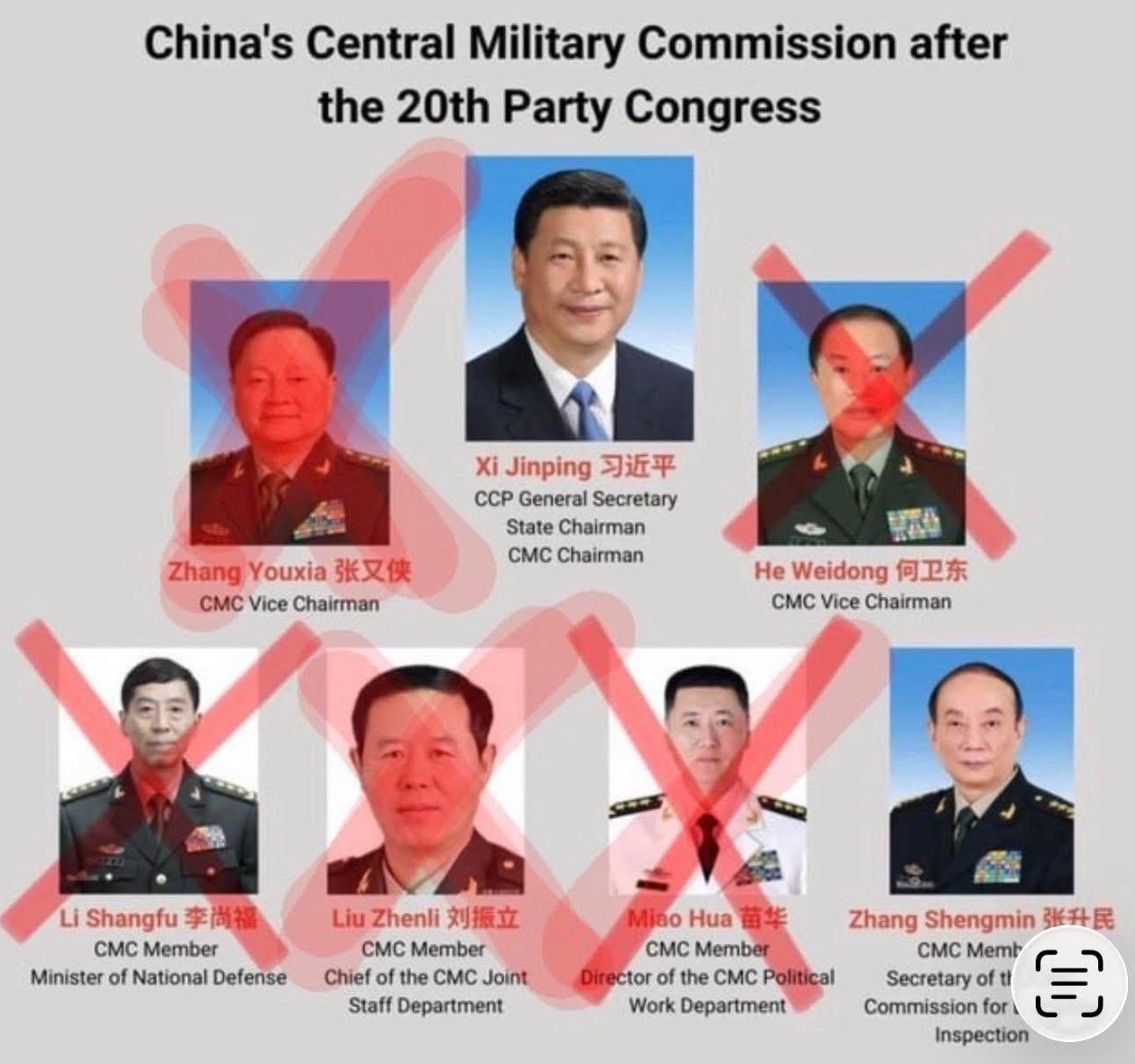
I briefly wrote about rumors that General Zhang Youxia was making moves to displace Chairman Xi Jinping, preemptively removing generals who were loyal to Xi. It seemed like a very real threat to Xi, and one could wishfully think that he (Xi?) might finally get deposed. Well, if you’re gonna come at the king, you best not miss, and Zhang missed, badly. Last week, it was reported that Zhang Youxia and his associate Liu Zhenli were being investigated (meaning “arrested” and probably now being tortured) for corruption and “serious breaches of military discipline”. These charges were later upgraded in state media to “leaking nuclear secrets to the United States for money”. Reports from discreet sources in China and posted on dissident sites here allege that Zhang and Liu launched a coup and sent a team to arrest Xi Jinping at a hotel, but Xi was tipped off and escaped the trap with hours to spare. A gunbattle supposedly ensued at the hotel, killing many on both sides, and Zhang and Liu were arrested soon after.
People have lots of questions, but this being the People’s Republic, there will probably never be any definitive answers provided. A sampling of some obvious questions:
China has nuclear secrets that America is interested in? And pay money for?
How many generals will China have left after this? For months, it seemed there was a sacking every week, and people are estimating that hundreds have been arrested in the last two years. I don’t care how big the PLA is, they can’t have that many generals in waiting to replace the purged ones, especially now that it looks like many more are going down. General Zhang was the highest ranking military officer in China for some time, and the only one active who had real combat experience (The Sino-Vietnam border war in 1979).
Why did it come to this? It’s been suggested that Zhang and other generals were reluctant to invade Taiwan, when doing so has been an obsession for Xi. They have good reason to not want to engage in a major war with a modern adversary, let alone the United States. Despite their dramatic buildup of new military hardware - a lot of missiles, shiny new fighter planes, a 600-ship navy, etc. - they are not ready for prime time. Chinese hardware has fared badly when featured in recent conflicts - Pakistan-India, Thailand-Cambodia, and most recently, Venezuela, where their shiny new “Made in China” radars failed to pick up the big Chinook helicopters that came to sweep away Nicky Maduro just hours after a Chinese delegation had visited him. Again, the last guy who actually fought in a shooting war was just purged, and he is 75 years old. After hearing “no” from the generals over and over, and then seeing why, Xi started to purge the leadership of the military, and Zhang knew he was next. Or something like that.
What comes next? People are expecting an attack on Taiwan, if for no other reason than the people saying “no” are out of the way, and also because Xi really needs people to be paying attention elsewhere right now. But maybe not. There will likely be months of follow-up purges, netting Zhang’s associates from among soldiers formerly under his command, school buddies, people from his village, patronage networks, and such. But you can’t get rid of all of them, and then you need someone left to fight if you are planning an invasion.
A more limited attack, with just drones, missiles, and cyber, or a naval blockade, perhaps, could satisfy Xi’s need to divert attention externally without exposing too many of the PLA’s flaws. But the aggressiveness of this move would have to be calibrated to do just enough damage and draw enough attention without causing a devastating counterattack on Chinese assets, such as a Taiwanese missile strike on the Three Gorges Dam, which the Taiwanese have been holding in their back pocket as a MAD-level threat to the PRC1.
Why does Xi want to take Taiwan now? Why not wait like everyone before him? It was said that when the Kuomintang were fleeing the mainland for Taiwan carrying treasures from the Imperial Palace2, the Communists wanted to sink those ships, but Mao Tse-tung restrained them, saying, ”We’ll get it back, just wait.” The Communist Chinese leadership generally has kept to this patient stance regarding Taiwan - until Xi Jinping. There are two main reasons:
The last people to be born before the One Child Policy took effect just turned 46 years old. It is the largest cohort to be born ever in China, and the number of births was pretty much halved (or worse) the very next year. Their kids are in their early 20s and late teens now. Accordingly, China’s population began to shrink for the first time since modern records were kept. A military requires a large population of young men, and those are starting to become more and more scarce. The old are outnumbering the young.
The second reason is related to the first. China has failed to become rich before it became old, and is running out of time before structural problems with its economy become devastatingly obvious3. Japan, Scandinavia, and France can weather a low birthrate because they have social safety nets and accumulated wealth. China has reached the demographic cliff far earlier in its developmental history, but its per capita GDP is around 5 times less than that of those countries. Its shrinking workforce will struggle to support its aging parents and grandparents, who are beginning to enjoy longer lifespans at a most inopportune time. There once was hope that, once become prosperous and powerful, the mainland could have persuaded Taiwan to unite with them peacefully, but the economic argument for that is starting to fade quickly, in addition to the longstanding socio-political unattractiveness of the PRC model.
So, an attack, or at least a provocation, on Taiwan is highly likely in the coming days, and Beijing watching as a spectator sport is entering overdrive - except that we are sitting in obstructed view seating. Xi is alone at the top for now, but let’s see for how long.
Another place where the situation on the ground is murky to the outside is Iran, where tens of thousands have been killed and arrested in the past month protesting the regime, but an internet blackout has been hindering communication within Iran and to the outside. The Shiite theocracy has been buying itself time with the blood of its people, but it is in a downward spiral as bad as or worse than China’s, politically, demographically, and economically. Its regional allies have been systematically dismantled by Israel, the US, and Syrian Sunni forces, and their air defenses and nuclear capabilities have been seriously degraded in the 12 Day War. Worst of all for them, almost nobody under the age of 40 cares about their revolution or their religion. The regime stalwarts’ loyalty is based on economic privilege, not ideological conviction, and early (pre-blackout) video out of the battleground cities suggest the riot suppression troops used to massacre protesters are Iraqi or Syrian Arab Shiite gunmen, and perhaps Hezbollah fighters, who have no qualms killing Persians. They and their home organizations have existential reasons to need Iran to remain a hardline Shiite theocracy.
The only thing preventing a wholesale revolution in Iran is the lack of a leader or central rallying point. The Iranian people - liberal youth and intellectuals, yes, but also ethnic Azeris, Kurds, Balochs, Arabs, and Jews, along with a mass of non-aligned people - can agree only that the mullah’s must go, but they don’t have a plan about who or what should take over next. That is why the Crown Prince of the exiled Pahlavi monarchy has become more prominent than at any point I can remember. Ironic, because his late father, the Shah, was overthrown in exactly the same circumstances. The difference was, the Shah couldn’t bring himself to order his troops to shoot his own people. On a related note, his son is issuing statements online from the US, where he lives in hiding. The lesson learned by despotic regimes since about June 1989 (Tiananmen Square) is that only the ruthless win. It seems Xi and Khamenei are very well versed in this truth.
If this dam were to be breached - which it might do all by itself one day, conservative estimates predict at least 30 million deaths.
Now displayed in Taipei’s National Museum
Massive debt, a bloated real-estate market, youth unemployment, and a preponderance of inefficient state-owned enterprises - any one of which could sink an economy by itself.