
Happy (belated) Darwin Day!
Perspectives from an evangelical Christian scientist

Thursday was the day celebrated in the UK and elsewhere (but usually not the US) to commemorate the birthday of Charles Darwin, known for his theory of natural selection, which has become the predominantly accepted mechanism to explain biological evolution. Since soon after the publication of his revolutionary work, On the Origin of Species, he and his intellectual legacy have been a lighting-rod of controversy throughout Western(-ized) civilization, usually along religious lines.
Does evolution (and science in general) contradict Christianity? As an evangelical Christian and as someone who makes his living doing science, I have grappled with this issue for my entire adult life. On the one hand I have met and heard of many professing Christians who have no problem with reconciling their faith and the findings of science1. I have also been told by some, in no uncertain terms, that I cannot be a Bible-believing Christian if I don’t believe that the world was created, fully formed, in six literal 24-hour days. What to believe? I have concluded that it is not a betrayal of faith - especially Christian faith - to accept things as true based on observable data and evidence. The Bible is based on the recorded eyewitness accounts containing falsifiable2 evidence of two momentous events - the Exodus, which was experienced by an entire nation and intricately encoded in their traditions, and the Resurrection of Jesus Christ, which was borne witness to by an entire community of people familiar with the matter who suffered and even died standing by their story. In short, Christians should respect the data, because we always have been data-driven.
Over time, I have arrived at a conviction that the Creation account of Genesis makes more sense, and is more powerful, in the light of modern science. This did not come from a weakening of my Christian doctrinal integrity, but from a closer reading of Scripture. Among other things, I have found that, while the Bible is written to be accessible to people from any time period, of all ages, backgrounds, and levels of education, it at the same time can speak to the most sophisticated mind possessed of modern assumptions, often in ways that should not have been possible given the level of scientific knowledge at the time of its writing. There are a lot of Easter Eggs in there for the modern science-minded person. For example:
The Genesis account tells us that the universe has a beginning - a point at which time itself began. This is consistent with the concept of the singularity in modern cosmology, first predicted by physicists such as Friedman and Lemaitre using Einstein’s theory of general relativity and confirmed as a materially observable reality by Edwin Hubble’s discovery of an expanding universe, which, traced back in time implies a singular origin point. It is a non-trivial point of agreement between the ultimate in modern science and the ancient utterings of scripture regarding the beginning of things.
This beginning point is now known to have been accompanied by an energetic expansion - a “Big Bang”3 - which within picoseconds was suffused with high-intensity photons mediating the furious energy exchanges between particles boiling in the hot primordial plasma, as the electromagnetic force diverged from the weak nuclear force. Ergo: “Let there be light.” In my time (not sure about now), Christian students at MIT often wore T-shirts emblazoned with Maxwell’s equations4:
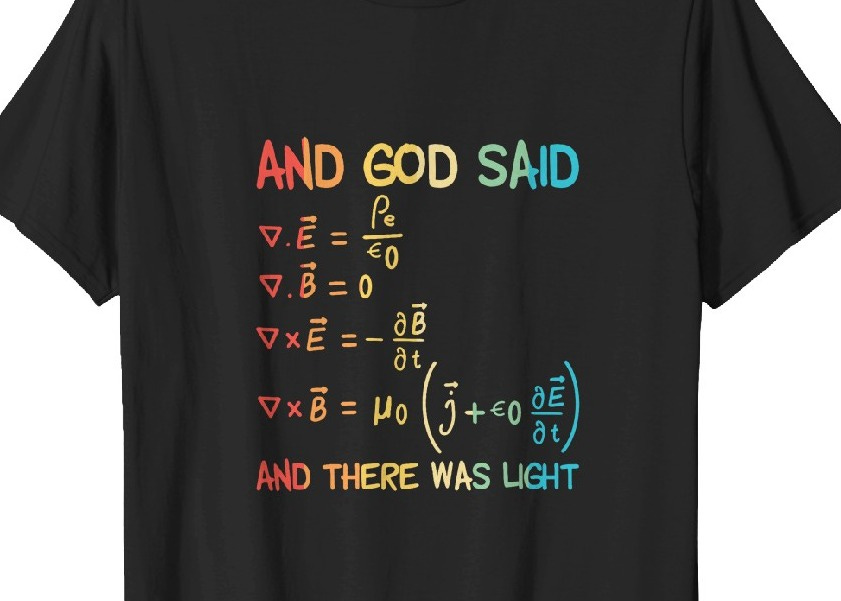
We who have grown up with the idea of the Big Bang may take it for granted, but the default worldview from ancient times (at least from Aristotle) was that of an eternal universe that always was5, and as recently as the ‘70s, influential physicists such as Fred Hoyle held to a universe without beginning. But the Bible description of creation hints that it had some insider information.
Along with the discoveries and measurements of the twentieth century came a growing realization that our very existence depends on a set of precisely calibrated physical constants, which must not deviate from their present values by more than some ludicrously small fraction6 in order for things like galaxies, protons, and stable atoms to have formed and persisted. One is hard-pressed to explain how the universe could be so perfectly balanced without invoking the action of a master designer, and this has unsettled thinkers for some time. The best that mathematical physics has devised to even remotely account for our improbably fine-tuned cosmos is the multiverse theory, in which we dwell in one of a practically infinite number of possible universes, each with a different set of fundamental physical constants, most of which are dead on arrival and the rest of which are barren of life, hellscapes of unstable and short-lived configurations of proto-matter. We and our universe just happen to be unimaginably lucky. The multiverse, intoxicatingly alluring and wonderfully adaptable as fodder for science fiction movies though it may be7, is pure speculation based on just one of many interpretations of quantum theory, with zero observable data to justify it.
All of this puts the idea of creation initiated by an intelligent being squarely in agreement with the scientific consensus, at least much more than folks commonly expect. One would think the Christian community would embrace this as a powerful tool to build bridges to non-believers. Instead, the Christian position is usually identified with a vehement and very loud constituency that advocates for the aforementioned literal six-day creationism, which insists each day of creation is equal to the 24-hour period of the insolation cycle we experience today as a result of earth’s rotation on its axis, and accuses any explanation of our origins that takes longer than these six days of being from the Devil. Under this assumption, we are backed into saying the Bible is wrong or science is, because the data is consistent with a universe and planet that are billions of earth-years old. This “old-earth” vs. “young-earth” controversy has turned whole congregations against accepted science, and entire generations against the Bible. The skirmishes are well-known, from the Scopes Trial to recent efforts to teach alternatives to evolution in schools. Although attempts have been made to bridge the two camps, and whole libraries have been written on the topic, those who cherish the Bible get stuck on the Genesis account of “days” of creation. Non-believers may say, “Why not discard the Bible?” Many have. But the Bible, for the reasons I put forth above and more, is too true and powerful to disregard lightly. As someone who is serious about the Bible as well as about science, I would like to step in. I believe in the Almighty God of the Bible who made all things. I also believe in what is carefully measured and recorded, peer-reviewed, and reproduced in independent settings. To me, the question boils down to: which interpretation of the Genesis account and definition of “days” (if any), fits the data?
The first step for me is to look at “days” in Genesis and think, “Whose days?” If you are talking about God and God’s work, you must be talking about God’s days, not the solar-based days of men. This is first implied in the text when the sun and moon are created not on Day 1, when days began being counted, but on Day 4. These lights are not yet called by name, though it is obvious what is meant by “lights to divide the day from the night”, but very generically described, focusing on their function, almost as if it were a spec-sheet or a planning memo for a Broadway show props crew, “I would like some lights here and here, to come in at the beginning of the set, and dim when the music ends.” The solar day is defined late in the game, and is therefore insignificant to the discussion. This is further accentuated by the parallel drawn later in the Bible between the days of creation and the days of the workweek and Sabbath stipulated in the Ten Commandments (Exodus 20:8-11). In short: “God worked six days, you work six days. God rested one day, you rest one day.” But God’s work and our work are not the same, and by extension God’s days and our days are not the same… otherwise the logical conclusion would be that we and God are the same. It is therefore natural to conclude - from the literal text - that the work and days of God are on a different order of magnitude than ours. Some have therefore identified these “days” as eons - sequential periods of millions or billions of years each, a construct commonly known as the “Day-Age theory”, and correlate them with stages in Earth’s evolutionary history. However, this idea is clunky and falls into obvious difficulties, as many of the things listed as being created on different days (e.g., plant and animal kingdoms) are clearly interdependent and had to develop in parallel, and could not wait millions or billions of years for the previous day’s creations to be completed.
Rather, it is more broadly consistent and defensible to think that God, who throughout the Bible is implied to be beyond and above time, on each respective Day was working out the necessary mechanisms to bring about and sustain each realm of existence (space, sea/air, earth and plant habitat) and its inhabitants (stars and planets, birds/fish, terrestrial animals and humans). He spoke - “Let there be…” to create8, and each time “called it a Day”. It was work - even for God, it didn’t just happen, and apparently it took a non-negligible amount of time and effort9. Here is where the believer must pay attention and cannot disagree: It is a pattern throughout the Bible that when God speaks, it is as good as done. “…and it was so.” Therefore, God can do work (by speaking) on a particular Day, and it is invariably so - even when it takes billions of years to become so in our experience of time. Each fundamental force, each chemical reaction, each genome sequence, planetary orbit, geological process, migration pattern, and meteor strike necessary for these creations to come into being at the right time and be sustainable, were defined and motivated by God in the Beginning, and it came about just as God willed and decreed. For example, creating light (D-1) implies the formulation of every fundamental interaction of physics (except maybe gravity), and designation of their aforementioned fundamental parameters. Separating the “waters above from the waters below” (D-2) describes a differentiation of vapor and liquid phases, which requires setting the thermodynamic properties of the constituent particles of these fluids (“waters”) and their balance with gravity and other forces. The dry ground (D-3) implies the existence of heavier elements, which requires stellar novae to generate them. In speaking each item into existence, God implicitly designed, initiated, and provisioned for the processes giving rise to the respective materials and structures.
“And it was so.” Every command was fulfilled to ultimately complete the vision of a thriving world, in His good time, unfurling over billions of years via apparently probabilistic mechanisms, through reversing, interleaving, roundabout pathways often transpiring in parallel, each creation mediating and supporting the others in a rich and evolving (yup) tapestry. The end result purposed by God was our world - located a perfect distance from a moderate-sized yellow sun, reasonably positioned on a spiral arm of the Milky Way to avoid most cosmic dangers, with a breathable atmosphere, abundant water, and populated by a menagerie of flora and fauna and microorganisms - that had come together by the time humanity emerged onto the scene, like a time-delayed drug release pill or a scheduled Uber Eats delivery. So yeah, God went to the office for six God-days (however long these might be, if time measures even apply to them), and did God-work, and the result is our universe, the way we observe it today, some 13.8 billion years old in hindsight.
We should not think it strange that God works over long periods of time in indirect and probabilistic ways. This is actually the m.o. of God throughout the Bible. It’s called Sovereignty and Providence, and in academia it is called being Boss. I compare it to the old McDonald’s commercial featuring Michael Jordan and Larry Bird, playing H-O-R-S-E for a Big Mac meal. Their mastery is accentuated, not diminished, by the creativity and complexity of their shots.
And God said, “Off the backboard, between the banners, … Nothing but net.” God does play dice, and He’s pretty super10 good at it. But some would reduce God to an artless dunker, incapable of working across any stretch of time beyond the immediate and most simplistic. If my God is like Michael Jordan, their God is… Dwight Howard.
Some other stray thoughts about Genesis:
Some created things are listed in detail, while others are conspicuously omitted - this was obvious even to the ancients, by the way - and therefore this list of things is best understood as a broad sketch of what God was envisioning for the world we inhabit, that was supplemented by a wealth of other things that support and enable the entire ecosystem according to the broader plan of creation. (Examples: Did God create the plants underneath the waters? If so, why are they not mentioned? Do the flying birds and insects only inhabit the sky? If not, why is it described in a way that would imply that they are only associated with the expanse above?).
The “waters”, which covered all creation and from which everything else is said to have been separated or created, if read as “H2O”, are a problem for the “literal” creationist, as outside of Earth, H2O is very rare in the universe (less than one part in a million, if even that). Even on Earth (radius approx. 4000 miles), it covers about three quarters of the planet’s surface to an average depth of less than a mile. It is nothing close to the all-encompassing “waters” of Genesis - it does not suffuse the cosmos, and it is not the source material of almost anything else. However, if you read it as “fluid”, then the primordial plasma and gas clouds of today, and even most of the bulk of the stars and gas giants, all can be described as “waters”. And if you read it as “hydrogen” - which is derived from the Greek word for “water” but for which the ancients had no word - then we have something, as hydrogen was ubiquitous in the early cosmos - and still is in all of the observable celestial objects listed above, and was also the feedstock from which the stars generated every other element.
The land animals are described as being “brought forth” from the ground. Sound anything like abiogenesis to anybody? Indeed, this statement, literally taken, covers all sorts of evolution. Again, God said it on the sixth Day, but “it was so” through a process stretching over many billions of years afterwards.11
The Genesis account does a very good job being relevant to both the ancients and modern-day intellectuals, all in a compact form factor. Imagine if Genesis intended to explain all of creation so it could satisfy modern scientific readers. It would have to cram The First Three Minutes by Stephen Weinberg, The Origin of Species, The Double Helix by James Watson, and probably a dozen other books into its narrative just to be acceptable. It would also have been burned as useless or worse almost as soon as it was written, as it would have been ridiculous and incomprehensible to people throughout most of history. Its brevity was partly a survival mechanism. Also, people had to recite it from memory. Even at its current length, we have a hard time getting people to read through it. You probably stopped reading this post already, for crying out loud.
The origin of mankind is a touchy subject, but the Bible suggests that we (humanity today) are the result of a combination of evolution and special creation, a view that I hope to elaborate on in future posts.
In short, I believe that Genesis, while not really trying to do so (it is obviously more focused on establishing the theological basis for the rest of the Bible), is consistent with modern science, and that my interpretation12 of Genesis is actually more literal and fundamentalist than the so-called “literal” and “fundamentalist” views of creationism. It is entirely possible that my views may be proven wrong. (But it is very certain that they will draw fire from both sides of the divide.) However, it is my best shot at making sense of the text, holding to its integrity and being serious about its implications to the rest of the Bible and the theology that emerges from it, while also being serious about the scientific findings of our time, about which I have strong professional certainty. I sincerely hope you, dear reader, might approach these issues of origins with the same seriousness.
Some of note include John Polkinghorne, Allan Sandage, Owen Gingerich, James Tour, and Francis Collins, all of them high-level researchers whose professionalism is undisputed.
At least they were falsifiable at the time they were written, to the contemporaries of the writers. We are able to do indirect due diligence today based on the record of their responses to the evidence.
This is a broad overview, and will not go into later modifications such as inflation theory. Also, I don’t have very deep mathematical knowledge of cosmology and higher theoretical physics. I became a materials scientist for a reason.
The equations describing the unified electrical and magnetic forces giving rise to the electromagnetic spectrum (light) in the non-relativistic limit.
Even the myths depicting the gods fighting and creating the world out of vanquished enemies’ carcasses presumed these gods were made out of something and lived somewhere.
Figures such as “1030” (ten followed by 30 zeros) routinely come up in the literature.
Its main function is to reboot superhero franchises with new actors and plots, so the studio can make more money with the same IP while saying, “Peter Parker looks like Tobey Maguire in one timeline/branch of the Multiverse, but Andrew Garfield (or Tom Holland) in another, but it’s not inconsistent or redundant. Every universe in the Multiverse has a Spider Man.” But in a real multiverse, there won’t be a human race, let alone a Spider Man, in pretty much any of the other universes.
The role of God’s speech (“The Word” in The Gospel of John, Chapter 1) in creation, and its identification with information - as in “Information Theory” - is a whole other article all by itself.
To those who would chide me for denying that creation took only six human days because “an Old-Earth view diminishes God’s power”, I would ask, “why not six hours? Six seconds? Six nanoseconds? Is God not able to work any faster than six days?” Any physical time unit is superfluous to God and rather arbitrary.
I typically would use other, more profane adjectives in situations like this, but not in the same sentence as, “God”.
This does not preclude elements of “special creation” or non-random Divine intervention at various times in the evolutionary history of the world.
My interpretation is not necessarily unique, as theistic evolution is a common position of many believers, such as Francis Collins (former head of the NIH) and his organization, BioLogos. Few authors I have read, however, try to tackle the “Day” issue literally as I do. John Lennox of Oxford is one I recommend as someone doing just that.
Many also eschew trying to kluge the text with scientific reality, preferring to focus on the theological and literary elements, which is fine for those who are not scientific-minded.